
CASE STUDY
Trussell
finding the power in community organising
Trussell is working towards a future where nobody needs a food bank, supporting food banks to work alongside their communities to understand and address the issues driving poverty, rather than only responding to its immediate effects. We evaluated its Organising Programme to explore whether it was building power in communities, what was changing within food banks, and what could help the work continue beyond Trussell’s direct support
The client: food today, change for tomorrow
There is a story about people falling into a river because the bridge is broken. First, you pull them out. Then you try to stop others falling in. Eventually, you go and look at the bridge.
We found ourselves returning to that story throughout our work with Trussell. A person who needs food today cannot wait for a bridge repair. But neither can we keep pulling people out of the water forever and call the job done.
Trussell’s Organising Programme is part of its ambition for a future where nobody needs a food bank. It supports Local Organisers to work alongside food banks and communities, understand the local issues driving poverty, bring people together and help them take collective action. By 2025, the programme had provided grants to 109 food banks across seven cohorts.
Trussell asked us to evaluate whether this was building power in communities. It also wanted to know what organising was changing inside food banks, and what might help the work continue after its direct support ended.
The challenge: what does growing power look like?
Make it stand out
Campaign wins matter. So do changes in policy. But organising often begins long before either appears.
It may start with a conversation between neighbours who have never met. A volunteer begins to see the food bank differently. Someone who has used its services helps decide what the campaign should be about. A group works out how to hold a meeting without its Local Organiser in the room.
How do you recognise those changes without declaring every good conversation a victory? And how do you compare them across places with different histories, resources and starting points?
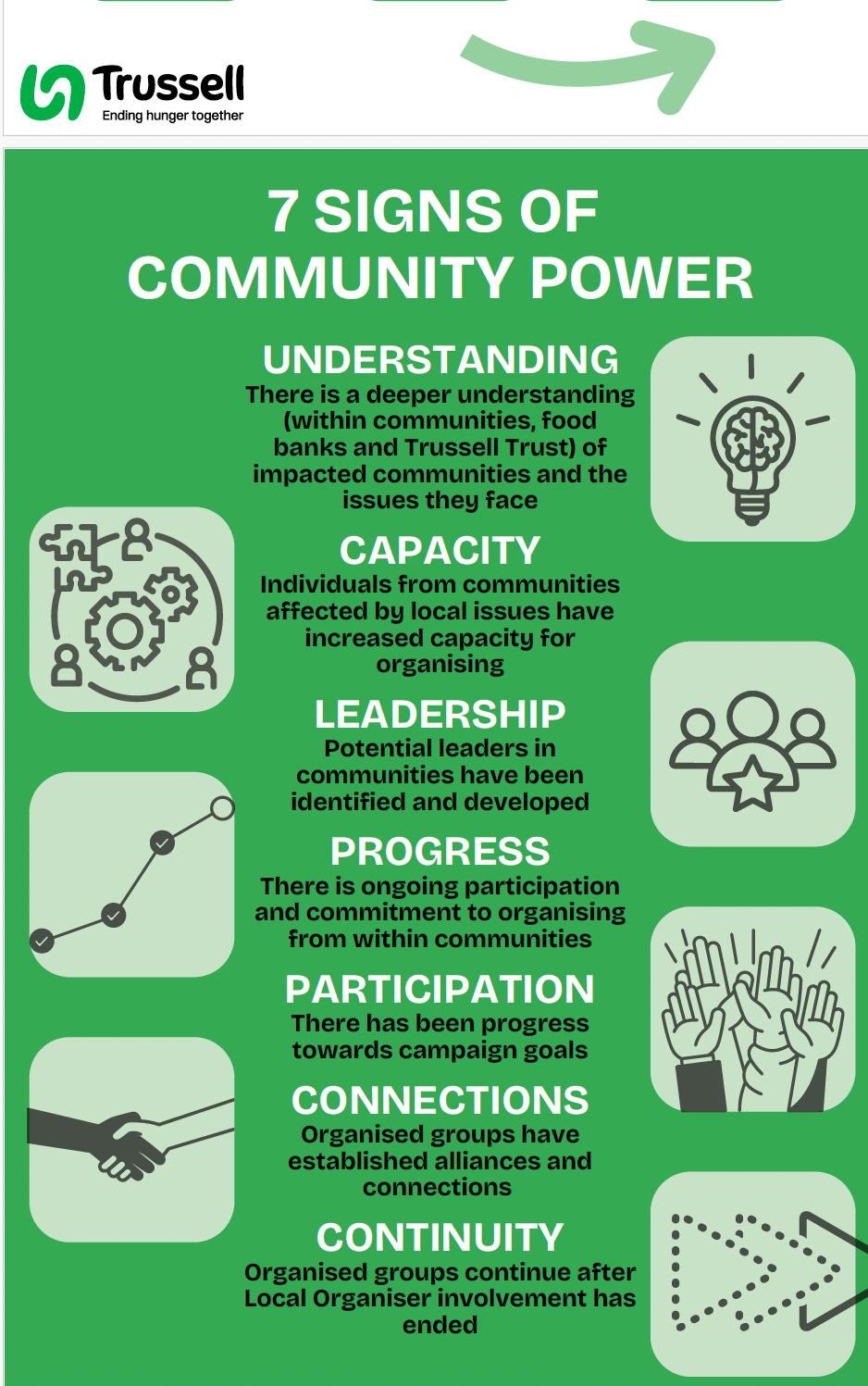
Trussell already had a promising answer: its seven Signs of Community Power. They describe growing knowledge, participation, skills, leadership, solidarity, continuity and campaign progress. Our job was to see how well those signs captured what was happening in practice, where the programme was making progress, and where the story was more complicated.
What we did: follow the evidence, then let people argue with it
We worked with Trussell’s Learning and Evaluation Manager and an eight-member Advisory Group that included Local Organisers and their managers. The evaluation ran from January to September 2025.
We started with existing evidence, including Local Organisers’ portfolios from the programme’s first two cohorts and internal reports. We read and coded the material, allowing themes to emerge before organising them against the evaluation questions. The result was a 32-column analytical matrix. That sounds rather formidable, but its purpose was simple: to help us see what evidence we had, where it came from, and which questions it could genuinely answer.
We also explored programme data using statistical analysis. The data was limited and uneven, so we treated this as a way to spot possible patterns and ask better questions. It could not establish that the programme had caused a particular outcome.
Then we went to people. We conducted 19 semi-structured interviews with Local Organisers, managers, food bank staff, Trussell colleagues and local partners. We visited Cardiff and Doncaster, spending around 16 hours face to face at each site with people in food banks and community settings. Being there helped us see how the relationships worked, and how differently organising could take shape in two places.
At Trussell’s two-day Campaign Festival, we observed how the Signs of Community Power appeared in people’s accounts of their work. Around 100 handwritten Stories of Change cards were collected there. We digitised and tagged them, adding those small, specific accounts to the wider evidence.
The most important step was bringing our emerging analysis back to the people closest to the programme. We held two online sensemaking sessions with Advisory Group members. Instead of showing them finished conclusions, we put visual versions of the evidence matrix on digital whiteboards. Participants worked directly on them, adding examples, objections and missing context.
Across the sessions, they contributed around 120 distinct notes. We also recorded, anonymised and analysed the discussions. Their contributions changed how we grouped and interpreted some of the findings. Participation here meant having a hand in the analysis, not being asked whether our slides looked right.
We shared a visual Story So Far while the work was still developing, too. It said plainly that these were incomplete working notes and invited people to tell us what was wrong, missing or useful. That felt particularly important for a project about power.
What we found: the bridge has more than one broken part
The evaluation found meaningful progress, but no single route by which it happened.
Some food banks were beginning to think of themselves as campaigners, connectors and conveners, as well as providers of emergency food. Some had made space for listening and campaigning in regular meetings; a few had begun to include organising in strategy or trustee papers. In other places, the work still depended heavily on one committed person.
We saw community groups building knowledge, confidence and relationships. Cardiff’s campaign team, for example, developed its work on public transport into sustained engagement with decision-makers. Elsewhere, groups were at much earlier stages, still listening and finding the issue around which people might act together. Those early stages count, even though they do not look much like a campaign win.
The seven Signs proved useful: the qualitative evidence we gathered could be understood through them. But the evaluation also made the conditions around the signs harder to ignore. Organisers need time to build trust. They need food bank leaders and trustees who understand the role, peers who can help them think, and resources for the small practical things that keep people involved. The “lone superhero” is a particularly poor sustainability plan.
The findings also contained friction: turnover, stretched roles, resistance to campaigning, and the emotional work of holding relationships together. We included those things because they help Trussell decide how to support the programme. A polished account of wins alone would have been considerably less useful.
What happened next: learning Trussell can use
The report gave Trussell a fuller account of how the programme contributes to change: through campaign action, through local relationships and awareness, and through changes in how food banks understand their own role. It recommended protecting time for relationship building, preparing food bank leadership for organising, supporting peers to learn from one another, and recognising progress before it becomes a formal win.
We cannot claim from this evaluation that every local change was caused by the programme. We can show how the programme has contributed, what appears to help, and where more support is needed.
Which brings us back to the bridge. Trussell’s food banks will keep helping people who need food today. The Organising Programme asks what is happening upstream. Our evaluation helped show something else: repairing the bridge is more likely to last when the people who cross it have power in what happens next.